BioBasicsBench: 7 Key Findings About AI in Scientific Research
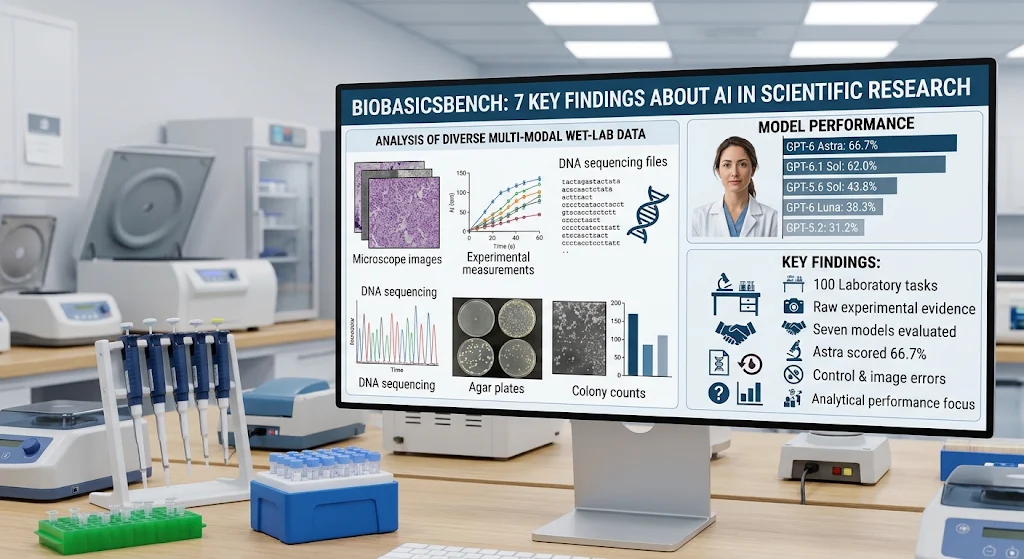
OpenAI introduced BioBasicsBench on November 6, 2026, to evaluate how accurately AI agents interpret raw biological laboratory data. The benchmark contains 100 tasks covering routine wet-lab activities, including microscopy, DNA analysis, protein methods, and experimental measurements.
In OpenAI’s evaluation, GPT-6 Astra achieved an average score of 66.7% at the highest tested reasoning-effort setting. However, the evaluation also revealed mistakes involving colony counts, experimental controls, and image interpretation.
These results highlight an important development in artificial intelligence: AI systems are becoming more capable of analyzing scientific evidence, but they still require human oversight.
Key Takeaways
- BioBasicsBench contains 100 biological laboratory tasks.
- OpenAI evaluated seven AI models across 37 model and reasoning-effort settings.
- The evaluation generated 18,500 results.
- GPT-6 Astra achieved a reported average score of 66.7% at the xhigh reasoning setting.
- The benchmark covers five major areas of wet-lab science.
- OpenAI documented mistakes involving experimental controls, image interpretation, and measurements.
- The benchmark measures analytical performance, not independent laboratory reliability.
What Is OpenAI BioBasicsBench?
BioBasicsBench is an evaluation benchmark designed to measure how well AI agents interpret routine biological laboratory evidence.
OpenAI developed it in collaboration with Ligo, a biotechnology company focused on enzyme design.
Unlike evaluations based mainly on text or polished scientific charts, BioBasicsBench uses raw experimental evidence. This includes laboratory photographs, microscopy images, sequencing files, instrument readings, and experimental notes.
The benchmark examines whether AI agents can:
- Interpret experimental data.
- Identify errors in laboratory evidence.
- Understand experimental controls.
- Apply relevant biological knowledge.
- Recognize when evidence is insufficient to support a conclusion.
These capabilities matter because scientific conclusions depend on accurate measurements and appropriate interpretation of experimental results.
1. BioBasicsBench Contains 100 Laboratory Tasks
The benchmark contains 100 tasks based on experimental data supplied by scientists.
These tasks cover five areas of routine wet-lab work:
- Protein methods
- Imaging and cytometry
- Quantification and assays
- Nucleic acid methods
- Molecular cloning
The questions range from reading DNA molecular weight from a gel image to analyzing more complicated experimental results.
Each task includes experimental evidence, a question, and expert-written grading criteria.
According to OpenAI, the tasks underwent multiple reviews, including internal scientific review and external review by a PhD-level wet-lab scientist.
This process was intended to improve the reliability of the questions and their evaluation criteria.
2. The Benchmark Uses Raw Experimental Evidence
One important feature of BioBasicsBench is its use of different types of laboratory data.
AI agents must interpret evidence in formats that scientists encounter during actual experiments.
The benchmark includes:
| Evidence type | Number of tasks |
|---|---|
| Gels and blots | 31 |
| Protocols, notes and specifications | 27 |
| Tables and instrument exports | 20 |
| Bench, apparatus and reagent photos | 18 |
| Microscopy | 14 |
| Instrument screens and plots | 13 |
| Sequencing files | 12 |
| Protocol videos | 7 |
| Agar plates and colonies | 7 |
| Reference sheets | 21 |
These categories overlap. A single task can contain multiple types of evidence, so the figures should not be added together as though they represent separate tasks.
This approach tests more than an AI system’s ability to answer questions from text. It also examines how well the system interprets images, measurements, documents, and experimental context.
3. OpenAI Evaluated Seven AI Models
OpenAI evaluated seven models using BioBasicsBench.
The evaluation covered 37 combinations of models and reasoning-effort settings. Each setting was tested on all 100 tasks, with five attempts per task.
This produced 18,500 results.
At the xhigh reasoning-effort setting, OpenAI reported the following average scores:
| AI model | Average score |
|---|---|
| GPT-6 Astra | 66.7% |
| GPT-6.1 Sol | 62.0% |
| GPT-5.6 Sol | 43.8% |
| GPT-6 Luna | 38.3% |
| GPT-5.5 | 35.4% |
| GPT-5.4 | 33.2% |
| GPT-5.2 | 31.2% |
These figures represent average credit earned against the benchmark’s grading criteria. They do not mean that the models successfully completed the same percentage of real-world scientific experiments.
For GPT-6 Astra, OpenAI reported a 95% confidence interval of 60.3% to 73.1%.
4. GPT-6 Astra Achieved the Highest Reported Score
GPT-6 Astra achieved an average score of 66.7% at the xhigh reasoning setting.
For comparison, GPT-5.6 Sol achieved 43.8% under the same reported setting.
This indicates a substantial performance difference within OpenAI’s benchmark evaluation.
The results also connect to a broader area of AI development: using advanced models to analyze complex technical information. For another example of AI being applied to demanding technical tasks, see our article on Anthropic Claude Verification: 5 Key AI Breakthroughs.
However, a higher benchmark score does not establish that a model can independently make reliable scientific decisions. The evaluation also identified situations in which GPT-6 Astra reached incorrect conclusions.
5. AI Still Struggles With Experimental Controls
Experimental controls help scientists determine whether an observed result is meaningful.
An AI system that misunderstands a control can produce an incorrect interpretation even when it recognizes other details correctly.
OpenAI documented an example involving a DNA cloning experiment.
GPT-5.6 Sol relied on the observation that a negative control plate contained no colonies. GPT-6 Astra noticed that the plate had been labelled with the wrong antibiotic.
That observation mattered because the incorrect antibiotic meant the plate could not serve as a reliable control for the experiment.
However, Astra also made mistakes elsewhere in the benchmark. In another cloning example, it selected the wrong colonies because it misinterpreted the relationship between experimental samples and reference results.
This demonstrates why identifying individual details is not enough. AI systems must also interpret those details in the correct experimental context.
6. The Evaluation Revealed Image Interpretation Errors
BioBasicsBench also tested how AI agents interpret microscopy images and other visual laboratory evidence.
OpenAI documented an example in which GPT-6 Astra incorrectly generalized that certain structures inside cells were darker than surrounding areas.
The images showed that some structures appeared lighter instead. Changes in microscope focus could affect the observed contrast.
The benchmark also identified an error in colony counting.
In one example, Astra missed visible colonies, failed to separate closely spaced colonies, and counted an empty area as a colony. Its final count was approximately 12% higher than the benchmark’s reference count.
Such errors can affect downstream calculations. For example, an incorrect colony count can distort an estimate of how efficiently DNA was introduced into cells.
These examples demonstrate why visual interpretation still requires careful verification.
7. BioBasicsBench Shows the Limitations of AI in Laboratory Work
The benchmark provides evidence of progress, but it also shows that AI agents are not yet dependable replacements for scientific judgment.
OpenAI’s evaluation identified several limitations:
- Incorrect assumptions: A model may apply familiar scientific expectations even when experimental controls contradict them.
- Image interpretation errors: Visual details can be overlooked or misunderstood.
- Measurement mistakes: AI may miscount objects or misread experimental results.
- Weak contextual reasoning: A model may identify individual observations correctly but fail to connect them to the experiment.
- Unsupported conclusions: AI may provide an answer even when the available evidence does not justify one.
These limitations matter because laboratory research depends on accurate measurements, appropriate controls, and conclusions supported by evidence.
BioBasicsBench offers a way to measure progress in these areas, but its results should not be treated as certification for autonomous laboratory work.
What BioBasicsBench Means for the Future of AI Research
BioBasicsBench highlights an important direction in AI development: evaluating systems on practical scientific tasks rather than relying only on general question-answering tests.
Scientific research involves more than retrieving information. Researchers must interpret uncertain evidence, identify experimental problems, and understand when a result cannot support a particular conclusion.
AI agents could potentially help scientists with routine data interpretation and experimental troubleshooting. However, the benchmark shows that these systems still need careful human oversight.
This development is part of a wider transformation in how AI processes and presents information. Our article on how AI search is reshaping SEO in 2026 discusses another application of increasingly capable AI systems.
Further improvements in scientific AI will require better image interpretation, stronger understanding of experimental controls, and more reliable reasoning across different types of laboratory evidence.
Conclusion
OpenAI’s BioBasicsBench provides a practical evaluation of how AI agents handle everyday biological laboratory data.
GPT-6 Astra achieved the highest reported score in the evaluation, but its mistakes also demonstrate why benchmark performance should not be confused with laboratory reliability.
The important finding is that scientific AI must become better at interpreting evidence, recognizing errors, and avoiding conclusions that experimental data cannot support.