Anthropic Claude Verification: 5 Key AI Breakthroughs
Anthropic has demonstrated how Claude can help verify the security of software at a deeper level than conventional testing. In research published on October 22, 2026, the company reported using Claude with its Theorem system to prove specific security properties across 123 open-source libraries and 239 program entry points.
The project generated approximately 180 million lines of Rocq proof code and identified bugs that extensive testing had missed. However, these results do not mean that every part of the tested software is completely secure. The proofs apply to specific properties under defined conditions.
This development highlights the potential of Anthropic Claude verification to help developers analyze complex software, identify hidden vulnerabilities, and improve security through mathematical proofs.
Key Takeaways
- Anthropic reported verifying security properties across 123 open-source libraries.
- The project covered 239 program entry points and generated around 180 million lines of Rocq proofs.
- Claude helped discover bugs that conventional testing had missed.
- Formal verification provides stronger evidence for specific properties than testing alone.
- The approach still has limitations and does not guarantee that software is entirely bug-free.
What Is Anthropic Claude Verification?
Anthropic Claude verification refers to using Claude’s AI capabilities to assist with formal software verification, a method that uses mathematical reasoning to establish whether software satisfies specific requirements.
Traditional software testing runs a program with selected inputs and checks whether it behaves as expected. Although testing is essential, it cannot realistically cover every possible input or execution path in complex software.
Formal verification takes a different approach. Developers define precise properties that software must satisfy and use mathematical proofs to demonstrate that those properties hold within a specified model.
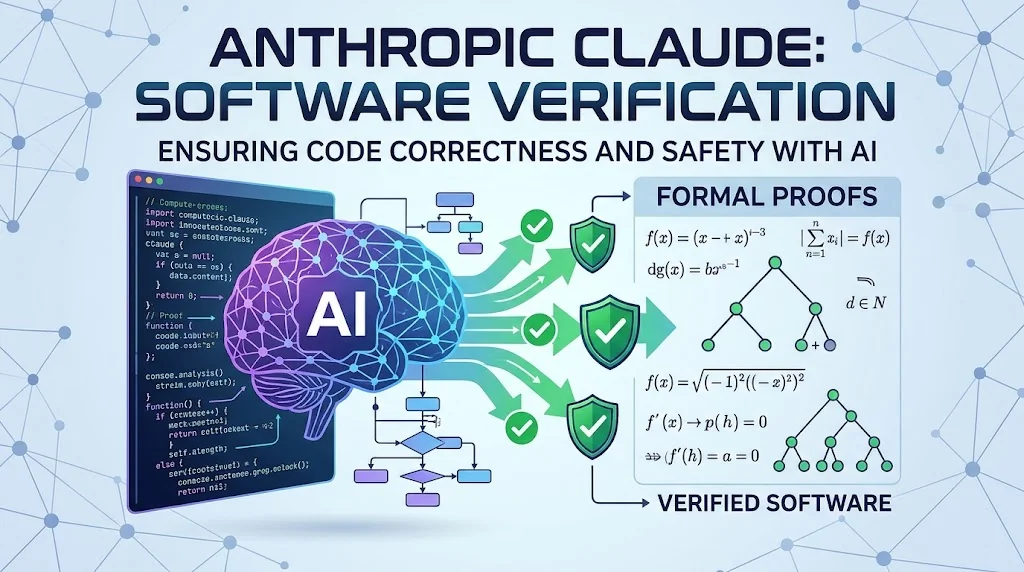
Anthropic’s research explores how AI can help make this process more practical. Claude assists with reasoning about code and producing formal proofs, while verification tools check whether those proofs are valid.
The important distinction is that AI can help construct a proof, but the verification system must independently validate it. This reduces reliance on the AI model’s ability to generate correct-looking answers.
How Anthropic Used Claude to Verify Open-Source Software
According to Anthropic’s published research, the project focused on verifying security properties at the assembly-code level using RISC-V software.
The researchers combined Claude with Theorem, their verification system, to help reason about program behavior and produce proofs that a formal proof checker could evaluate.
The process involved several important steps:
- Analyze the software: Examine program code and identify the security properties that need verification.
- Define the requirements: Express the desired behavior as precise mathematical statements.
- Generate formal proofs: Use AI assistance to develop the reasoning and proof code needed to establish those properties.
- Check the proofs: Use formal verification tools to determine whether the proofs satisfy the defined requirements.
- Investigate failures: Examine counterexamples and other evidence to identify potential software defects.
This approach can reduce some of the manual work traditionally associated with formal verification. However, defining the right security properties and interpreting the results still require careful engineering.
5 Key Breakthroughs in Anthropic Claude Verification
1. Verification Across 123 Open-Source Libraries
One of the most notable findings was the reported scale of the project.
Anthropic used its approach across 123 open-source libraries and 239 program entry points. These results suggest that AI-assisted formal verification may be applicable beyond small demonstration programs.
Formal verification has historically required substantial expertise and engineering time. Automating parts of the process could make it more accessible to teams that cannot afford to verify every component manually.
Nevertheless, the number of libraries alone does not establish how secure every library is. The significance depends on which properties were specified, which code paths were covered, and whether the proofs accurately represented the software’s intended behavior.
2. Approximately 180 Million Lines of Rocq Proofs
Anthropic reported generating around 180 million lines of Rocq proof code during the project.
Rocq is a proof assistant used to develop and check mathematical proofs. In software verification, it can help establish that a program satisfies formally expressed properties.
Producing proofs at this scale would be extremely demanding if every step required manual work. AI assistance offers a potential way to accelerate the process.
However, the number of lines is not a direct measure of software quality or security. A large proof may reflect the complexity of the code, the proof strategy, or the amount of supporting detail required. The real value comes from the validity and relevance of the verified properties.
3. Bugs That Conventional Testing Had Missed
Another important result was the discovery of bugs that extensive testing had not identified.
Software tests are designed to exercise important scenarios, including unusual inputs and expected failure conditions. Yet a test suite can only cover a limited set of executions.
Formal verification can reveal violations of specified properties that ordinary testing may overlook. For example, a proof attempt might expose an unexpected memory-access condition or a failure to satisfy a required security constraint.
Finding such issues does not automatically mean every discovered bug is exploitable. Developers must investigate the findings, reproduce relevant behavior where possible, assess the risk, and determine the appropriate fix.
Still, using AI-assisted verification alongside established testing methods could help teams uncover defects earlier in development.
4. Security Analysis at the Assembly-Code Level
The research examined software at the assembly-code level, focusing on RISC-V programs.
Assembly-level verification can provide a detailed view of program behavior. It may help identify problems that are difficult to reason about when examining higher-level source code alone.
This matters because software security depends not only on what developers intend a program to do, but also on how its compiled instructions actually behave under the relevant conditions.
However, low-level verification is technically challenging. Researchers must model the relevant instruction semantics and specify what counts as correct behavior.
Anthropic’s reported work demonstrates a possible way to combine AI assistance with formal methods at this level, but its conclusions should not be generalized to every processor architecture or software environment.
5. A Potentially More Practical Approach to Formal Methods
Perhaps the broader breakthrough is the possibility of reducing the cost and effort of formal verification.
Formal methods can offer strong guarantees about carefully defined properties, but producing proofs often requires specialized knowledge and significant manual effort.
Claude may help engineers develop proof strategies, explore complex code, and generate the supporting formal reasoning. A proof checker then provides an independent mechanism for validating the result.
This combination could make verification more practical for selected security-critical software components.
The technology is not a replacement for skilled developers, security researchers, or established testing practices. Instead, it may give those teams additional ways to examine software and establish stronger evidence of correctness.
What Are the Limitations of AI-Powered Software Verification?
Despite its potential, Anthropic Claude verification has important limitations.
Proofs Cover Specific Properties
A formal proof establishes that a defined property holds under the assumptions and model used in the verification process. It does not automatically establish that the program meets every security requirement.
If a critical property is omitted, the proof may be valid but incomplete from a broader security perspective.
The Results Depend on the Verification Model
Anthropic’s reported research used a defined environment involving RISC-V, Linux-related semantics, single-threaded programs, static binaries, and fixed-memory assumptions.
These constraints matter. Software operating under different architectures, concurrency conditions, memory models, or runtime environments may require different verification work.
AI-Generated Proofs Still Need Checking
An AI model can produce reasoning that looks convincing but contains mistakes. Formal proof checking helps address this risk by validating whether a proof follows the formal rules.
Even so, developers must ensure that the specification and underlying model accurately represent the behavior they want to guarantee.
Formal Verification Does Not Eliminate Every Vulnerability
A verified component may still be affected by issues outside the properties covered by its proofs. Vulnerabilities can also arise from dependencies, configuration errors, interactions between components, and assumptions that do not hold in production.
For these reasons, formal verification should complement security reviews, automated testing, fuzzing, and ongoing vulnerability management.
How Could Anthropic Claude Verification Affect Software Developers?
If AI-assisted formal verification becomes more practical, it could change how development teams approach software security.
For software developers, it may help identify subtle defects and establish stronger evidence that critical functions behave as intended.
For open-source maintainers, it could provide another way to examine security-sensitive libraries, although adoption will depend on available resources and the relevance of the properties being verified.
For cybersecurity teams, formal proofs may strengthen assurance for selected components. Teams would still need threat modeling, penetration testing, and broader system-level assessments.
For businesses, the technology could eventually help reduce certain software risks, particularly in systems where correctness and security are essential. Actual benefits will depend on verification costs, implementation quality, and how well the method fits the software.
The most realistic near-term outcome is a combination of AI-assisted reasoning and established engineering practices—not fully autonomous software security.
Is Claude Better Than Traditional Software Testing?
Claude-assisted formal verification and traditional software testing serve different purposes.
| Approach | Main purpose | Key limitation |
|---|---|---|
| Traditional testing | Check behavior across selected scenarios | Cannot normally test every possible execution |
| Fuzz testing | Find failures using many generated inputs | Findings depend on coverage, inputs, and detection methods |
| Formal verification | Prove specified properties under defined assumptions | Requires accurate specifications and a suitable model |
| AI-assisted verification | Help develop formal reasoning and proofs | AI output must be checked, and the verification scope remains limited |
These methods work best together. Testing can reveal unexpected behavior, fuzzing can explore unusual inputs, and formal verification can establish guarantees about carefully defined properties.
Claude’s potential contribution is to reduce some of the effort needed to produce those proofs.
What Does This Mean for the Future of AI Coding Tools?
AI coding tools are increasingly being evaluated on more than their ability to generate code quickly. Reliability, security, and the ability to validate results are becoming important parts of the discussion.
Anthropic’s research suggests that AI can assist with a task traditionally associated with specialized formal-methods expertise. If the approach becomes easier to apply, developers may be able to verify more security-sensitive components than they could using manual methods alone.
However, broader adoption will require evidence about cost, scalability, accuracy, maintenance, and real-world effectiveness. Independent evaluation and reproducible results will also help determine how well the approach performs across different projects.
For now, the research represents a promising direction rather than proof that AI can independently guarantee software security.
Conclusion
Anthropic Claude verification demonstrates how AI can help scale formal software verification. Anthropic reported analyzing 123 open-source libraries, covering 239 program entry points, and finding bugs that extensive testing had missed.
The key achievement is not simply generating code or producing millions of lines of proofs. It is using AI to help establish mathematically checked guarantees about specific software properties.
The approach still depends on accurate specifications, suitable verification models, and careful engineering. Combined with testing and security reviews, however, it could become a valuable tool for building more reliable software.
You May Also Read It : How AI Search Is Reshaping SEO in 2026