Gemini 4 Hydrogen: 7 Powerful Features of Google’s New AI Model
Google introduced Gemini 4 Hydrogen on November 12, 2026, as a new AI model designed for fast coding, everyday tasks, and agentic workflows. It is also bringing the model to Google Search to improve how users explore complex questions and discover relevant information.
Google reports improvements in speed, coding performance, and instruction following. Here are seven important features, along with the model’s pricing, availability, and potential impact.
Key Takeaways
- Google announced Gemini 4 Hydrogen on November 12, 2026.
- The model focuses on fast coding and agentic workflows.
- Google reports that it completes certain tasks 2.5 times faster than Gemini 3.8 Flash.
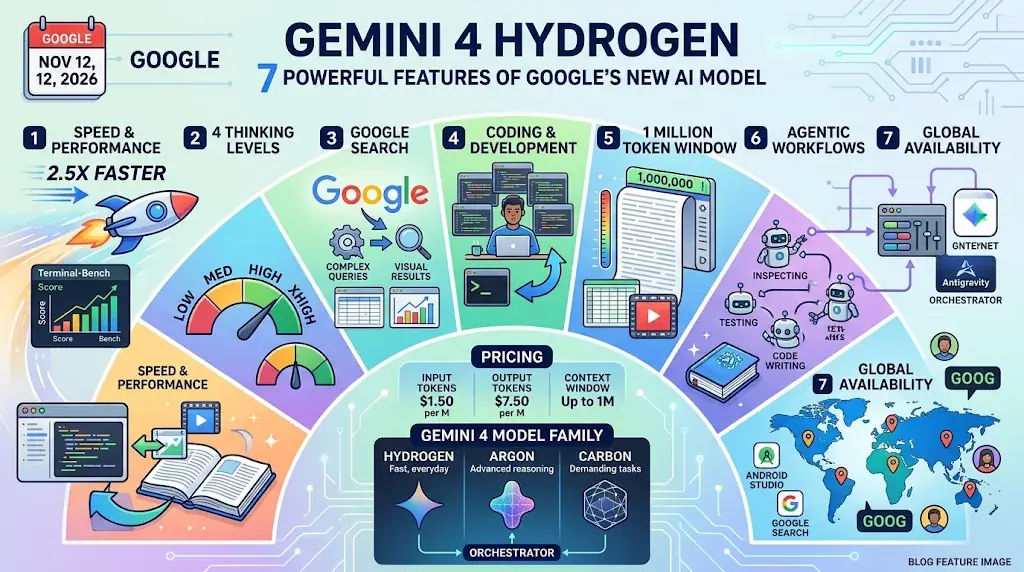
- It supports four thinking levels: low, medium, high, and xhigh.
- It supports up to one million input tokens and up to one million output tokens.
- Google is introducing Hydrogen across Search, the Gemini app, and developer products.
- API pricing starts at $1.50 per million input tokens and $7.50 per million output tokens.
What Is Google Gemini 4 Hydrogen?
Gemini 4 Hydrogen is Google’s AI model designed for fast execution across coding, research, business, and agentic workflows.
It belongs to Google’s Gemini 4 model family, which also includes Gemini 4 Carbon and Gemini 4 Argon.
The models serve different purposes. Carbon and Argon focus on demanding reasoning tasks, while Hydrogen is designed for rapid execution across everyday work.
Google also plans to use Hydrogen across its consumer, developer, and enterprise products.
1. Gemini 4 Hydrogen Is Designed for Faster AI Workflows
Speed is one of the main features Google highlights in Gemini 4 Hydrogen.
According to Google’s announcement, Hydrogen completes tasks 2.5 times faster than Gemini 3.8 Flash at its default high thinking level.
Google also reports that Hydrogen achieved a 57% score on Terminal-Bench 4.1, compared with 18.2% for Gemini 3.8 Flash.
Terminal-Bench evaluates how well AI systems perform tasks in command-line environments.
These figures come from Google’s own evaluations and should not be treated as independent benchmark results.
The improvements could be useful for developers who regularly ask AI systems to write code, inspect repositories, identify bugs, and modify software projects.
2. It Supports Four Thinking Levels
Gemini 4 Hydrogen includes four configurable thinking levels:
- Low: Designed for faster responses and simpler tasks.
- Medium: Balances response speed and reasoning.
- High: The default setting for more demanding everyday tasks.
- Xhigh: Provides additional reasoning depth for complex requests.
This flexibility allows developers to select the reasoning level that suits a particular task.
For example, a simple formatting request may not require the highest reasoning setting. A complicated debugging task may benefit from deeper reasoning.
These options can help developers balance response quality, processing time, and API usage.
3. Google Is Bringing Gemini 4 Hydrogen to Google Search
One of the most important parts of this announcement is its integration with Google Search.
Google says Gemini 4 Hydrogen is being introduced globally to improve how Search handles complex questions.
The update focuses on three main capabilities.
Better Understanding of Complex Questions
Users can ask questions containing multiple requirements, specific conditions, or unclear wording.
Google says Hydrogen improves Search’s ability to understand user intent and address different parts of a query.
More Relevant Search Results
Google is improving its query fan-out approach, which allows Search to explore related subtopics simultaneously.
This can help connect users with a broader range of relevant websites and information.
More Visual Search Responses
Google says Search can provide more visual responses, including:
- Images
- Comparison tables
- Structured information
- Custom tools
- Other interactive elements
These changes could make complicated searches easier to understand.
For publishers and SEO professionals, this development is worth monitoring because it may affect how users discover websites through Google Search.
Techmexa has also covered this wider development in its article on AI search in 2026.
For additional details, read Google’s official explanation of the Gemini 4 Hydrogen Search upgrade.
4. It Improves Coding and Software Development
Gemini 4 Hydrogen is designed to help developers complete everyday software engineering tasks more efficiently.
Google highlights several coding capabilities:
- Writing and modifying code in existing repositories.
- Finding and fixing software bugs.
- Answering questions about large codebases.
- Building interactive websites.
- Running development tools.
- Handling repeated coding and debugging tasks.
One important capability is its ability to work with existing code without unnecessarily rewriting unrelated files.
Google also says Hydrogen can handle parallel file-reading and search operations, helping it inspect complex projects more efficiently.
These capabilities make it relevant to developers who want AI assistance throughout their software development workflows.
For a related example of AI being applied to specialized technical tasks, see Techmexa’s article on Anthropic Claude verification and its key AI breakthroughs.
5. Gemini 4 Hydrogen Supports a One-Million-Token Context Window
Another notable feature is Hydrogen’s large context window.
Google states that the model supports up to one million input tokens and up to one million output tokens.
A large context window can help an AI system process extensive information within a single workflow.
Potential applications include:
- Analyzing large documents.
- Reviewing software repositories.
- Processing spreadsheets and reports.
- Understanding recorded videos and audio.
- Combining information from multiple sources.
However, a large context window does not guarantee that every detail will be interpreted correctly.
Developers should still evaluate the model’s accuracy when processing lengthy or complex information.
6. Google Introduces Gemini 4 Hydrogen for Agentic Workflows
Gemini 4 Hydrogen is also designed to work with AI agents.
Agentic workflows allow AI systems to perform multiple steps toward a goal, sometimes using external tools and software.
For example, a coding agent may inspect a repository, identify a problem, modify relevant files, run tests, and review the results.
Google is also introducing Orchestrator in its Antigravity development platform.
Orchestrator can switch between models such as Gemini 4 Carbon and Hydrogen during a workflow.
According to Google, its Orchestrator evaluation on Terminal-Bench 4.0 achieved task success rates close to Carbon while consuming 24% less quota on average and completing tasks 19% faster.
These are Google’s reported benchmark results, not independent guarantees of performance in every development environment.
The approach demonstrates how different AI models can work together rather than relying on one model for every task.
7. Gemini 4 Hydrogen Is Available Across Google’s Products
Google announced a global rollout of Gemini 4 Hydrogen across its developer, enterprise, and consumer products.
| Platform | Availability |
|---|---|
| Gemini API | Available through Google AI Studio |
| Android Studio | Available through its paid tier |
| Gemini for business | Available through supported business offerings |
| Google Antigravity | Available to eligible Google AI Pro and Ultra subscribers |
| Gemini app | Available through model selection; free users can receive it through automatic model selection when appropriate |
| Google Search | Rolling out globally to users |
Availability can vary by product, subscription, and rollout status.
Developers can use the Gemini API to integrate Hydrogen into their own applications.
Gemini 4 Hydrogen Pricing
Google has published the following API pricing:
| Pricing component | Cost |
|---|---|
| Input tokens | $1.50 per million |
| Output tokens | $7.50 per million |
| Context window | Up to 1 million tokens |
The pricing makes Hydrogen an option for developers who need a model for frequent coding and agentic tasks.
Actual API costs depend on input size, output generation, reasoning settings, and application usage.
Developers should consult Google’s current pricing documentation before estimating production expenses.
How Is Gemini 4 Hydrogen Different From Gemini 4 Carbon and Argon?
Google’s Gemini 4 models are designed for different workloads.
| Model | Main purpose |
|---|---|
| Gemini 4 Hydrogen | Fast everyday coding and agentic execution |
| Gemini 4 Argon | Advanced reasoning and complex knowledge work |
| Gemini 4 Carbon | Demanding long-horizon tasks, coding, research, and cybersecurity |
Hydrogen is intended to handle frequent tasks efficiently, while Carbon and Argon are positioned for more demanding reasoning requirements.
The ability to combine these models through Orchestrator may help developers balance speed, performance, and usage costs.
What Does Gemini 4 Hydrogen Mean for SEO and Website Publishers?
The integration of Gemini 4 Hydrogen into Google Search is particularly relevant to website owners and SEO professionals.
Google says the updated Search experience can better understand complex queries, explore related topics, and provide a wider range of relevant links.
For publishers, this makes it important to create content that answers specific questions clearly and provides useful information beyond basic summaries.
Website owners should continue focusing on:
- Accurate and original information.
- Clear headings and logical content structure.
- Helpful explanations that satisfy search intent.
- Relevant supporting evidence and sources.
- Strong internal linking.
- Useful content that deserves to be referenced.
The announcement does not mean traditional SEO is disappearing. It does mean that changes to AI-powered search experiences are worth monitoring.
Conclusion
Gemini 4 Hydrogen brings faster coding, agentic workflows, and improved Search capabilities to Google’s AI ecosystem. Its real value will depend on how well it performs in practical applications and how users respond to the updated Search experience.